How to Review AI Tools: A Framework for Affiliates Promoting in the AI Boom

The AI tool landscape has exploded. With the generative AI market projected to grow from $40 billion in 2022 to $1.3 trillion over the next decade, a flood of new products has created a gold rush for affiliate marketers. AI affiliate programs now routinely offer 20-50% commissions with recurring revenue models, making them some of the most lucrative opportunities in the industry.
But here’s the challenge: most affiliates promoting AI tools are doing their audiences a disservice. They’re highlighting features and commission rates without helping readers understand whether a tool will actually deliver value. When 67% of affiliate marketers are actively deploying AI in their operations, the bar for credible AI tool reviews has never been higher.
Your audience deserves better than feature lists and pricing comparisons. They need a framework for evaluating whether an AI tool will genuinely move their business forward and you need that same framework to maintain credibility as an affiliate.
The Four-Metric Framework: How to Evaluate AI Tools That Actually Deliver
Every AI tool you review should be measured against four core metrics. If a tool doesn’t demonstrably improve at least one of these, it’s not worth recommending to your audience:
Time ROI measures how many hours the tool eliminates or frees up. This is often the easiest metric to quantify and the most immediately compelling to your audience. When reviewing an AI writing assistant, for example, don’t just say it “speeds up content creation.” Quantify it: How long does a typical 1,500-word blog post take with the tool versus without it? What’s the realistic hours saved per week for different use cases?
Output ROI examines whether users can accomplish more with the same resources. An AI scheduling tool might not save hours directly, but it could enable a single social media manager to handle three times as many accounts. This scalability factor matters enormously to small businesses and solopreneurs in your audience.
Accuracy ROI addresses error reduction and consistency improvements. AI transcription services, for instance, should be evaluated on accuracy rates across different audio conditions, accents, and terminology. A 95% accuracy rate might sound impressive until your audience discovers they’re spending significant time correcting the remaining 5% of errors.
Cost ROI compares what the tool costs against the monetary value it generates or preserves. This is where many affiliate reviews fall short they mention pricing but fail to contextualise it against realistic value creation. An AI tool costing £200 per month that genuinely saves 10 hours of work at a £50/hour rate delivers clear positive ROI. One that saves 2 hours doesn’t.
Asking the Right Questions Before You Promote
The question most affiliates ask about AI tools is fundamentally flawed: “Is this AI system good?” The better question is: “Does this system actually move the user’s business forward?”
This distinction matters because the AI market is saturated with tools that are technically impressive but practically useless for most users. A sophisticated large language model that can write poetry doesn’t help a plumber generate more leads. An advanced image generation platform doesn’t benefit someone who needs help with inventory management.
Before promoting any AI tool or affiliate program, run through these evaluation questions:
What specific problem does this tool solve? Vague promises about “increasing productivity” or “leveraging AI” are red flags. The best tools have clear, specific use cases that your audience will immediately recognise as relevant to their situation.
Who is the ideal user? AI tools designed for enterprise clients won’t serve solopreneurs well, and vice versa. Understanding the intended user helps you match recommendations to the right segments of your audience.
What does the learning curve look like? A powerful tool that takes three months to master may not suit an audience looking for quick wins. Conversely, overly simplified tools might frustrate technically sophisticated users.
What happens when it fails? Every AI tool has limitations and failure modes. Understanding these helps you set realistic expectations and maintain credibility when readers encounter issues.
The Core KPIs Your Audience Needs to Understand
When helping your audience evaluate AI tools, these key performance indicators provide a practical framework for assessment:
Manual Touchpoints Eliminated counts how many human steps the tool removes from a workflow. Every manual step represents a delay, a cost, and a potential failure point. An AI email assistant that still requires users to manually copy responses into their email client eliminates fewer touchpoints than one with direct integration.
Execution Time measures how long it takes to complete a task from start to finish. This before-and-after comparison often provides the clearest ROI signal. If an AI SEO brief generator reduces the time to create content briefs from 3 hours to 20 minutes, that’s a concrete benefit your audience can evaluate.
System Success Rate tracks how often the tool runs without breaking or requiring intervention. This matters more than many affiliates realise. A fast system that breaks frequently isn’t automation—it’s frustration. When reviewing tools, look for reliability data and user reports about uptime and error rates.
Cost per Execution calculates what each use of the tool actually costs. This includes subscription fees, API usage charges, infrastructure costs, and any third-party integrations. Some AI tools have attractive base prices but become expensive at scale due to usage-based pricing models.
Adoption Rate examines whether people actually use the system after purchasing. Low adoption often indicates failed automation, even when the technology works perfectly. Tools with steep learning curves, poor onboarding, or clunky interfaces suffer from this problem regardless of their technical capabilities.
Practical Examples for Your Reviews
When creating content about AI tools, concrete examples help your audience visualise the value. Here’s how to frame AI tool benefits in terms that resonate:
For AI content systems, move beyond generic claims about “faster writing.” Instead, map the workflow transformation: Before automation, a content strategist might spend 3-5 hours per article on SERP analysis, competitor research, and outline creation. After implementing an AI content system, that same work might take 30 minutes of review and approval. For teams producing 20 articles monthly, that’s potentially 50-60 hours redirected toward higher-value activities.
For AI prospecting and outreach tools, quantify the multiplication effect. Manual prospecting might yield 50 qualified leads per week. An AI-powered system could process 5-10 times more domains while reducing preparation time by 70%. These concrete comparisons help your audience assess whether the tool fits their scale and needs.
This approach to leveraging AI for affiliate marketing success applies whether you’re reviewing tools for your own use or recommending them to your audience.
What Your Audience Really Needs to Know
When creating AI tool reviews, focus on the information your readers actually need to make informed decisions:
Realistic onboarding expectations help readers prepare for the learning investment. How long does it take to become proficient? What support resources are available? Are there community forums or knowledge bases for troubleshooting?
Integration requirements matter more than many reviews acknowledge. An AI tool that doesn’t connect with your audience’s existing tech stack creates friction that reduces adoption. Specify what platforms, APIs, or systems the tool works with—and which ones it doesn’t.
Data privacy and security considerations have become increasingly important. Where does user data go? How are inputs processed? For audiences in regulated industries or those handling sensitive information, these details can be deal-breakers.
Pricing transparency should include the full picture, not just the headline rate. What usage limits apply? What happens when users exceed them? Are there hidden costs for features that most users need?
Cancellation and refund policies deserve mention in every review. AI tools with free trials let audiences test before committing. Those without trials should offer clear refund policies that reduce purchase risk.
Maintaining Credibility in Your AI Tool Reviews
The principles of transparency in affiliate marketing become especially important when promoting AI tools. Your audience is bombarded with hype about artificial intelligence, and they’re increasingly sceptical of overblown claims.
Always disclose your affiliate relationship prominently. The latest FTC guidelines and ASA rulings make clear that affiliates must inform audiences when content is commercially motivated. Beyond legal compliance, transparent disclosures build trust by demonstrating honesty about your incentives.
Never fabricate statistics or invent user testimonials. The AI space is ripe with exaggerated claims, and participating in that hype damages your long-term credibility. If you haven’t personally tested a tool, say so. If you’re relying on company-provided data, acknowledge that limitation.
Be willing to highlight limitations and drawbacks. Reviews that only mention positives read as advertisements, not evaluations. Your audience knows that no tool is perfect, and acknowledging weaknesses demonstrates that you’ve genuinely evaluated the product.
Compare tools fairly to alternatives. Many AI categories have multiple viable options, and your audience benefits from understanding how competing tools stack up. This approach serves readers better than treating every product as the best option available.
The Real Measure of AI Tool Value
After evaluating dozens of metrics and KPIs, one question cuts through the noise: Does this tool enable business growth without proportional increases in cost or headcount?
That’s the fundamental promise of AI automation. Not fancy interfaces, complex workflows, or impressive technical specifications but genuine leverage. Automation that removes friction, compresses time, and increases output per person.
If you can’t demonstrate how a tool delivers this leverage using concrete metrics, you’re promoting an experiment rather than a solution. And experiments don’t deserve your audience’s money or trust.
The best AI tools for affiliate marketing solve real problems in measurable ways. They eliminate manual processes, accelerate workflows, and scale operations without proportional resource increases. When you find tools that genuinely deliver these outcomes, you have something worth recommending.
Building Your AI Tool Review Template
For affiliates serious about creating valuable AI tool content, consider developing a standardised evaluation framework. This ensures consistent, comprehensive reviews and helps your audience make like-for-like comparisons.
Your template should include sections for:
Problem Definition: What specific challenge does this tool address? Who experiences this problem most acutely?
Solution Overview: How does the tool approach the problem? What methodology or technology does it use?
ROI Analysis: Using the four-metric framework, what measurable improvements can users expect?
User Experience: What’s the learning curve? How intuitive is the interface? What support resources exist?
Limitations and Considerations: Where does the tool fall short? What use cases doesn’t it serve well?
Competitive Context: How does this tool compare to alternatives? What makes it distinctive?
Recommendation: For whom is this tool best suited? Who should look elsewhere?
This structured approach sets your content apart from the superficial reviews flooding the AI tool space. It positions you as a trusted authority rather than just another affiliate pushing products for commission.
The Opportunity Ahead
The AI tool explosion creates genuine opportunity for affiliates who commit to quality. As AI continues to reshape affiliate marketing practices, audiences will increasingly seek trusted voices who can cut through the hype and identify tools worth their investment.
For those willing to invest in thorough evaluation and honest communication, the rewards extend beyond commission cheques. Building a reputation as a reliable source for AI tool recommendations creates long-term audience loyalty and positions you for the ongoing growth in this space.
The affiliates who succeed won’t be those promoting the most tools or chasing the highest commissions. They’ll be the ones who consistently help their audience separate genuine solutions from experiments and who earn trust by being right more often than they’re wrong.
Your framework for evaluating AI tools isn’t just a content strategy. It’s a competitive advantage in an increasingly crowded market. Use it well.
Looking to expand your AI affiliate portfolio? Explore our comprehensive guide to high-ticket AI affiliate programs offering substantial recurring commissions across ten essential categories.
KonverJ’ agency team has been fully certified with Webgains, a leading UK affiliate network, strengthening its knowledge of the network,…
Read More
Affiliate Does More Than Win the Last Click Last week we attended Awin ThinkTank UK 2026. It was an interesting…
Read More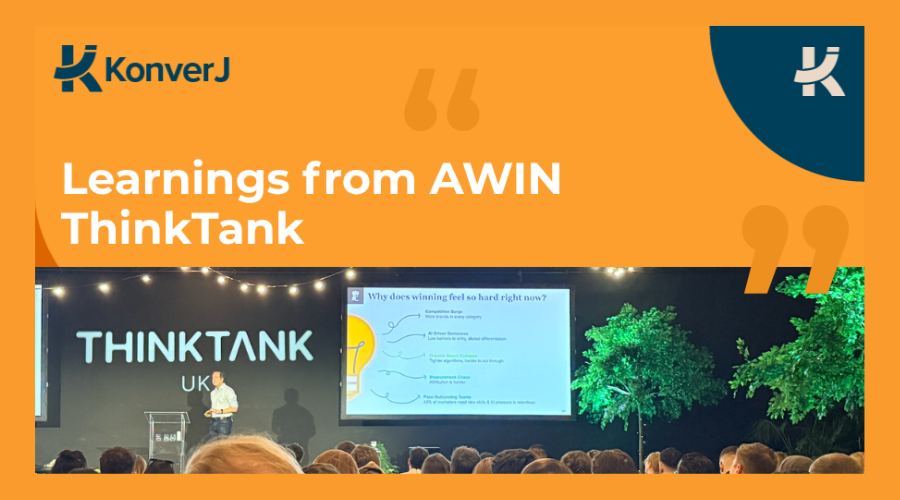
KonverJ leadership strengthens industry support as CEO Lee-Ann Johnstone joins the Performance Marketing Association’s new B2B Council. KonverJ is proud…
Read More