Stop Waiting for a Better Account Manager: the Escalation Path Doesn’t Exist
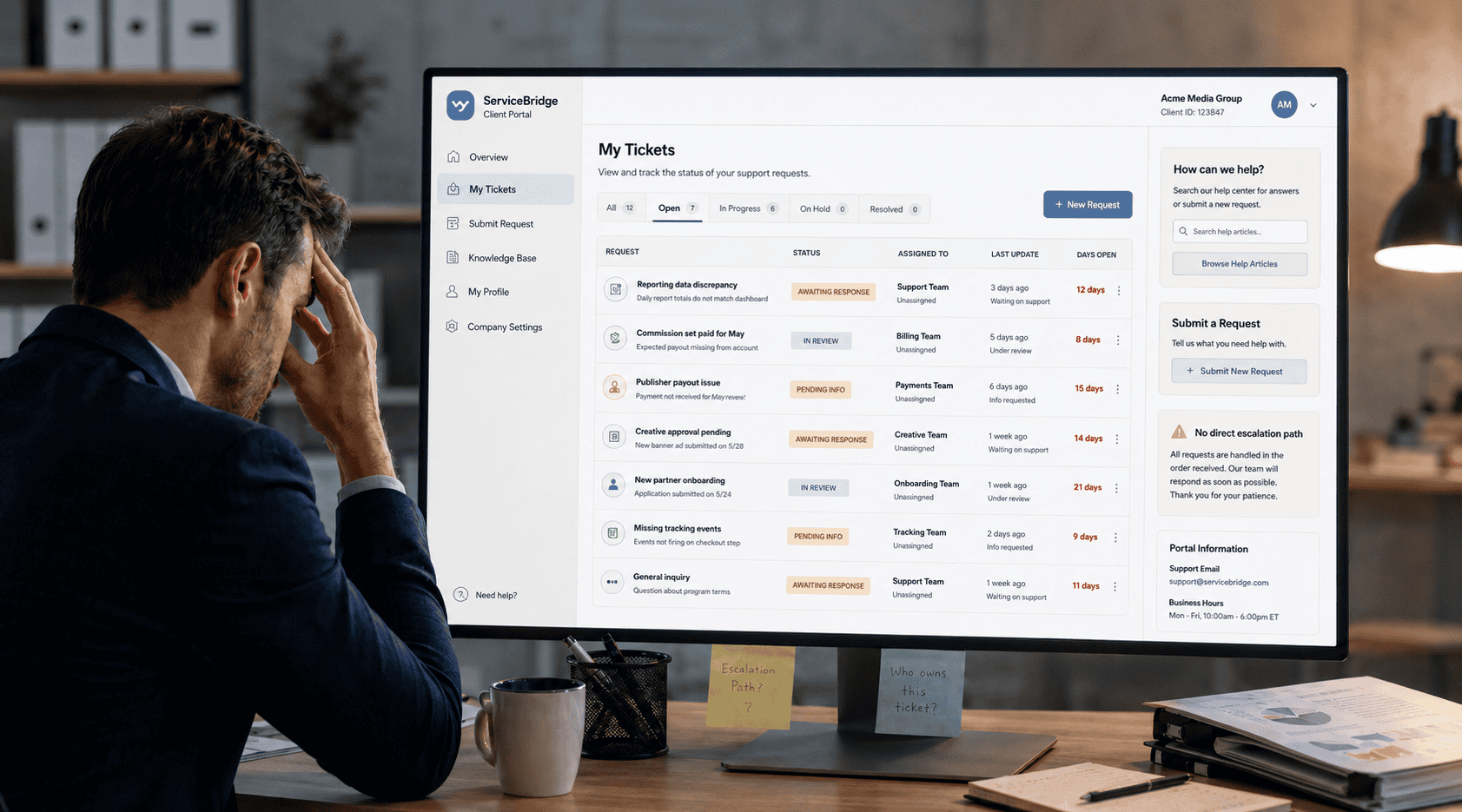
Everyone who has run an affiliate program for more than a year has the same story. A ticket goes in. Nothing comes back. You chase it in the next call, your account manager says they’ll look into it, and the thread quietly dies. Six weeks later you raise it again as if it were new, because functionally it is.
The usual reading of this is that you got a bad account manager and the fix is a better one. Escalate. Ask for someone more senior. Threaten to move volume elsewhere.
That reading is wrong, and acting on it costs you a quarter.
The maths behind the black hole
Networks grew their advertiser books faster than they grew their account teams. That is the whole explanation. A single AM carrying thirty to sixty accounts has, on any given week, a few hours per account at absolute best, and most of those hours go to whoever shouted loudest or spends the most. Your ticket is not being ignored out of malice. It is competing with fifty-nine other tickets for the same afternoon.
Escalation assumes there is a tier above the queue with spare capacity and authority. In most networks that tier is a manager who carries their own book plus the overflow, which is the same constraint one level up with a better job title. You are not escalating out of the queue. You are joining a shorter one that moves at the same speed.
This is structural. It is not a reputation problem with one network, and swapping platforms buys you a honeymoon period and then the identical arithmetic.
A great AM still can’t fix your program
Here is the part that gets missed. Even when you land an AM who is sharp, responsive and genuinely wants to help, the ceiling is low, because of what the role actually is.
An account manager manages the platform relationship. They handle tracking issues, tag deployment, network reporting, partner introductions from the network’s own book. That is a real job and good ones do it well.
What they do not have is your program’s history. They do not know that the commission structure was set in 2023 for a product mix you no longer sell. They were not there when you onboarded that content partner and agreed a temporary uplift that never got reviewed. They cannot tell you why your top ten converts differently from your next fifty, because they have never seen your margin data, your returns rate or your customer LTV by partner type.
Most AMs inherit an account mid-flight with no handover beyond a spreadsheet. Turnover in network account teams is high, so the average tenure on your account is often under a year. Every rotation resets the context to zero. You end up being the institutional memory for your own program while asking someone with none of it to make decisions about it.
So the escalation path doesn’t exist, and neither does the person you were escalating to. You are looking for program ownership in a seat that was never designed to hold it.
What actually closes the gap
The fix is someone on your side of the table who holds the context and watches the program continuously.
Ticket-driven management means you only find out about a problem after it has already cost you something. A partner’s traffic drops 40% in March, nobody notices until the April numbers land, and by the time anyone asks the partner has already reallocated their placement to a competitor and won’t be coming back. The ticket you raise in May is about something that was fixable in March.
Continuous means someone is looking at partner-level performance weekly, knows which shifts are seasonal and which are not, and picks up the phone before the drop becomes a departure. It means commission structures get reviewed against current margin rather than left running on 2023 logic. It means recruitment happens against a defined gap instead of whoever the network suggested that month.
That work is not glamorous and it does not fit in a queue. It just needs doing, by someone with the history in their head.
Fit beats size when choosing a partner
The instinct at this point is to go and hire a bigger agency, on the theory that scale means capability.
Look at what happened at the network. Scale is exactly what created the problem. A large agency running two hundred programs has the same capacity maths, the same book-per-head ratio and the same context loss on staff turnover. You get a nicer logo on the deck, a named lead who is spread across eleven accounts, and the day-to-day handled by someone eighteen months into their career who is learning your program on your budget.
Fit is the question worth asking. Does the person who sold you the engagement do the work, or hand it off? How many programs does your actual day-to-day contact carry? Have they run a program in your vertical, with your margin profile, at your scale? Can they tell you something uncomfortable about your current setup in the first meeting, or do they only tell you what a great opportunity it is?
Those questions sort partners far better than headcount does.
Why we can answer those questions
KonverJ is built around the senior people being in the programs, not just describing them at conferences. Our team has run advertiser programs, sat on the network side, and managed partner relationships through the parts that go wrong. We keep books deliberately small so the person who diagnosed your problem is the person who fixes it, and so the context lives with someone who is still there in eighteen months.
That is the only reason the advice above holds up. It comes from having been the person with the dead ticket.
Before you do anything, run this check
Answer these from memory. Speed matters more than accuracy.
- How old is your oldest open network ticket?
- Which partner’s performance moved most in the last quarter, and do you know why?
- When was your commission structure last reviewed against current margin, and what changed?
- Who were your last three partner recruits, and where did they come from?
- What percentage of your revenue sits with your top five partners?
If you can answer all five in under a minute, your program is in reasonable shape and your frustration with the network is probably about response times, which is fair enough.
If you stalled on two or more, the escalation path was never the issue. You have a visibility problem, and no AM anywhere was going to solve it, because they cannot see it either.
That is a fixable thing, and the first step is small. A program audit tells you where the gaps actually are, with numbers rather than instinct.
If you would rather just talk it through first, a strategy call works too, and if the answer at the end is that you need someone holding the program day to day, we do that as well.
Start with whichever of those matches how much you already know. Book a call with the KonverJ team.
Search your own brand name right now. Not your product. Your company. There’s a real chance the top result isn’t…
Read More
When did you last sit down and properly review the commercial terms your affiliate program is running on? Not glance…
Read More
AEO and GEO are some the hottest topics in marketing right now – here’s what they mean for your brand…
Read More