What Does Affiliate Marketing Actually Cost You Per Customer?

Affiliate is sold to finance teams on one line: you only pay when you get a sale. That line is why the channel gets approved, and it is also why the numbers stop making sense about eighteen months in.
The claim is technically true and commercially incomplete. Commission is the visible cost. It is rarely more than two thirds of what the channel actually costs you per customer, and the missing third is where most programs quietly lose their case.
Work out the real number first
Affiliate CAC is total channel cost divided by new customers acquired through the channel. Both halves of that are usually wrong in the reports brands show us.
The cost side needs all of it:
Commission paid. Network override, which sits on top of commission at most networks and typically runs 20% to 30% of the commission value. Platform or SaaS licence fee if you are on Impact, Partnerize, Everflow or similar rather than a network. Tenancy, placement and newsletter fees paid to publishers, which are fixed costs regardless of whether they convert. Agency or in-house salary cost. Content and creative production for partners.
Run that properly and a program reporting a 12% commission rate is often carrying a 17% to 19% all-in cost of sale.
The customer side is where the bigger error lives. Most brands divide total channel cost by all affiliate-attributed orders. That gives you cost per order, not cost per acquired customer. Split new from returning. In a mature retail program, cashback and loyalty partners will be sitting on a returning-customer share north of 60%, and paying acquisition-level commission on repeat purchases is the most common way a program’s CAC goes bad without anyone noticing.
If you have not revisited what you pay for what, our piece on commission structure covers the review in more detail.
The comparison that matters
Against paid search, affiliate usually wins on cost and loses on control. Against paid social prospecting, affiliate usually wins on both. Against organic and email, it loses.
That last comparison is the one to be honest about, because it is where the incrementality question lives. If a customer was going to buy anyway, found you through brand search, then passed through a cashback extension at the basket, you have not acquired anyone. You have paid commission on a sale you already had, plus override on top of it.
The uncomfortable version of the question: what share of your affiliate-attributed revenue would have happened without the channel? Until you have tested that, your affiliate CAC is an accounting figure rather than a marketing one. We go further into the testing methods in our guide to affiliate incrementality.
How to test it rather than argue about it
Three methods, in ascending order of rigour.
Deduplication analysis is the cheapest. Look at how many affiliate conversions also carry a paid search or direct touch in the same session or the preceding hour. If your network is deduplicating against paid search on a last-click basis you may already be netting these out. Many brands are not, and never checked.
Partner-level holdout is the practical one. Suspend a single partner type, usually the largest cashback or extension partner, for four weeks in one market. Track total revenue rather than affiliate revenue. If total revenue holds while affiliate revenue drops, that spend was not buying you incremental customers.
Geo holdout is the rigorous one and needs scale. Switch the channel off entirely in a comparable market and measure the total delta. It is disruptive and worth doing once.
When affiliate CAC gets worse, not better
Affiliate CAC rises quietly. The pattern is consistent across the programs we audit.
Partner mix drifts towards the bottom of the funnel. Cashback, loyalty and voucher partners are easy to recruit and convert reliably, so they grow as a share of the program while content and review partners stagnate. Blended commission rate looks stable. Incrementality falls.
Commission gets set once and never revisited. Rates that made sense at launch, when you needed partners to take a chance on you, are still running three years and considerable brand awareness later.
New and returning customers are paid identically. This is the fastest available fix and most programs have not made it.
Voucher code leakage goes unpoliced. Codes intended for a specific partner end up aggregated on general voucher sites, and you pay commission for a discount you did not intend to give.
Left alone long enough, the pattern compounds. We documented what that looks like at the far end in this account of an always-on program that was inflating acquisition costs and attracting fraud.
What actually reduces it
Split commission by customer type. Pay meaningfully more for a new customer than a returning one. This one change typically shifts program economics within a quarter, because it redirects partner effort rather than just cutting cost.
Move budget from commission into fixed placements with content partners you have tested. Counter-intuitive, since it breaks the pay-for-performance principle, and it works because content partners sit earlier in the journey and buy you customers that the bottom-funnel partners cannot. Sourcing them is a different discipline from network recruitment, which is why we run partner discovery and recruitment as separate work.
Price commission against margin, not revenue. Category-level commission rates are standard practice and most programs still run a single flat rate across a catalogue with wildly varying margin.
Fix validation and returns handling. If commission is approved before your returns window closes you are paying for revenue that reverses.
What this looks like in practice
On a recent program audit, we restructured commission to reward new customer acquisition over repeat purchase, rebuilt the partner activation journey and cleared the approval bottlenecks that were losing qualified partners. Affiliate-referred sales rose 53% within three months. Active partners grew 116% over six months. Time to activation fell by 40%.
None of that came from spending more. It came from paying for the right thing.
Where to start
If you cannot currently produce a single figure for what one affiliate-acquired new customer costs you, all-in, that is the first thing to fix. It usually takes a week of data work and it changes the conversation with finance permanently.
For a quick read on whether your program has this problem, our program health check takes a couple of minutes and will tell you which direction to look in.
Beyond that, our program audit produces the number itself, alongside a partner-level incrementality view and a commission structure built around your margin rather than the network’s template. Where the finding is that the program needs running differently rather than restructured once, that moves into ongoing program management.
Book a program audit. We will give you your true affiliate CAC and show you which partners are earning it.
Search your own brand name right now. Not your product. Your company. There’s a real chance the top result isn’t…
Read More
Everyone who has run an affiliate program for more than a year has the same story. A ticket goes in….
Read More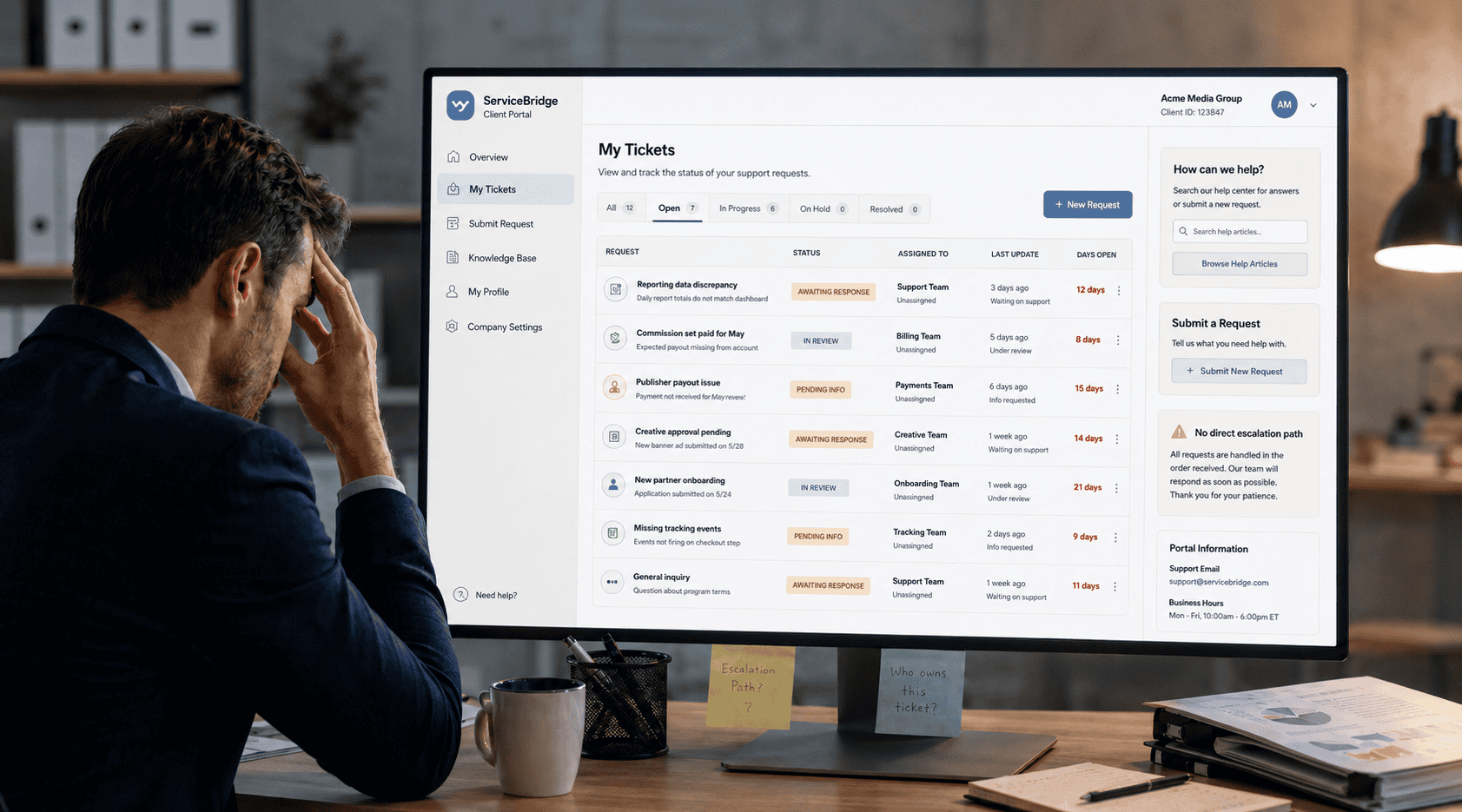
When did you last sit down and properly review the commercial terms your affiliate program is running on? Not glance…
Read More