Beyond Cold Call: Mastering Affiliate Pitches Leveraging B2B Buyer Insight

Affiliate program managers recruiting B2B partners face a challenge that traditional sales teams solved years ago: breaking through inbox noise to reach decision makers who control partnership budgets worth thousands per month. While consumer affiliate recruitment often relies on self-service platforms and broad outreach, B2B partnership development demands the precision and sophistication of modern sales prospecting.
New research from Sopro’s State of Prospecting 2026 report, analysing 126 million emails and surveying 442 B2B decision makers, reveals why most partnership outreach fails and what affiliate managers can learn from these insights and their sales teams who consistently win meetings with senior stakeholders.
The B2B Buyer Has Changed: What It Means for Affiliate Recruitment
Affiliate managers pursuing B2B partners encounter prospects who behave fundamentally differently than they did even two years ago. According to the research, 89% of consumers or buyers now use generative AI in at least one area of their purchasing process, from discovering potential products to evaluating and justifying their decisions. In the context of affiliates as your buyer – many engage with partnership managers, only once they’re typically already well on the way through their research journey to the program or people that support it. Most affiliates have already found or have a preferred vendor or product to promote to their traffic when your email hits their inbox. The opportunity to convince them to promote your program is slim and needs to be effective.
For affiliate recruitment tactics are mirrored somewhat in the insights shared in this recent sentiment analysis created by Sopro – it carries insight into how we can improve our partner outreach campaigns. B2B partners researching your program have likely evaluated competitors, read case studies, and formed opinions about commission structures before your outreach email arrives. The window to influence their decision happens earlier and more independently than traditional recruitment models assume. We are living in a world where trust matters.
Partnership managers must therefore build visibility and trust now – getting through to new creators and publishers within the research phase rather than expecting one well-crafted pitch email to convert cold prospects into active partners.
This means it’s imperative that you invest in marketing and promoting your affiliate program – not just sending out sales emails to entice and solicit affiliate interest but building impact, resonance and trust.
Why Traditional Affiliate Outreach Underperforms
Most affiliate managers inherit recruitment tactics from consumer-focused sales programs that prioritise volume over precision. The research reveals why several common approaches actively reduce response rates:
The education trap: Sopro’s sentiment analysis of 650,000 prospecting emails found that messages attempting to educate new prospects underperformed the baseline by around 24%. Prospects don’t expect lessons in a cold call outreach email – they want confidence that you understand their business challenges and can solve their problems and convert their customers quickly. Affiliates want to earn more money – finding ways to help them do that with your program, product or service is the only thing that’s important to get across in that first outreach email you send to them.
Problem-led framing backfires dramatically: Opening with statements like “You might be struggling to earn revenue when clicks are being lost” reduced cold call performance by almost 45% compared to opportunity-focused messaging as a first time outreach. For affiliate managers, this means avoiding assumptions about potential partnership pain points in favour of highlighting specific revenue opportunities that may be being missed.
Social proof doesn’t work in one-to-one outreach: Despite being recruitment staples in the past, references to “trusted by 1000’s of other affiliates” or testimonials from successful partners actually reduced the performance of cold call emails by around 12%. Real social proof comes from other people building and confirming your credibility, not self-promotion in cold emails. Affiliate managers are now their own brand ambassadors – and need to lead their program growth on a basis of trust in what they are preaching and delivering.
The most effective outreach instead emphasises distinctiveness (what makes your program uniquely different), collaboration framing (positioning the relationship as a partnership rather than vendor arrangement), and time-discounting bias (promising credible near-term results without context).
The Complexity Reality: Affiliate businesses aren’t one man bands and multiple sales persons may need to be reached.
In B2B partnership decisions involve an average of 4 variant stakeholders according to the research, with 48% involving three to five people for a deal, sale – or campaign to go live. This complexity has increased substantially, driven by generational shifts as Millennials and Gen Z now comprise a higher percentage of your target affiliate or creator audience. For affiliate program managers, this means partnership approvals rarely come from a single contact. The marketing manager initially interested in your affiliate program must convince finance about commission structures, legal terms compliance, and potentially IT about tracking implementation. Each stakeholder evaluates different criteria: ROI, risk mitigation, technical feasibility, and strategic fit – taking much longer to get the deal to go live. Successful B2B affiliate recruitment therefore requires strategies that map every stakeholder who influences partnership decisions.
Timing Misalignment: Why Partnership Recruitment Emails Fail
B2B buying cycles span three to eleven months on average – the same can be said for affiliate recruitment. Timing is everything. If you’re reaching out with a timed promotion or offer and then not reaching out again with brand follow up you’re missing out on converting a partner to your program when the time is right for them! (not you).
Most affiliate recruitment campaigns run for four to six weeks before stopping or swapping. The research found that when sales campaigns pause due to seasonality or promotion drop offs, a lot of engaged leads can then go silent mid-process, often only resurfacing months later after being influenced by competitor outreach or sales pipelines
Partnership managers recruiting B2B affiliates must therefore treat outreach as a continuous growth infrastructure rather than sporadic outbound or seasonal recruitment campaigns. The research conducted found that the majority of respondents agree prospecting is essential for new business and growth, yet only half of them maintained always-on engagement. Those maintaining consistent visibility throughout selection phases position themselves as familiar options when validation and onboarding conversations finally begin.
The moral of this story is don’t think 3-5 emails are enough – stay prominent and relevant with communication that is helpful to be front of mind with affiliates and wait for their timing to match yours.
Precision Over Volume: Building Better Partner Audiences
The report’s most striking finding challenges conventional recruitment wisdom: when Sopro used AI to filter audiences by true suitability rather than surface-level firmographic fit, lead rates barely changed, but conversion to closed deals increased 356%.
What this means for Affiliate Managers – when doing your affiliate recruitment, get targeted with your outreach initiatives. Smaller, sharper audiences deliver dramatically better outcomes than broader all affiliate mass targeting.
For affiliate managers, this precision approach means moving beyond basic filters like “SEO affiliates with 10,000+ site clicks” toward sophisticated targeting that considers business models, growth patterns, product positioning, and partnership readiness signals that indicate genuine fit rather than superficial qualifications. Just because an affiliate has traffic, doesn’t mean it’s going to convert. So figure out why and what you are requiring from partners of this type before you email them! Poor targeting doesn’t just waste time, it damages your sending reputation through irrelevant outreach that triggers spam filters and reduces inbox placement for subsequent messaging.
What Actually Works: Data-Backed Outreach Tactics
Analysis of all that B2B email performance revealed some specific approaches that affiliate managers can learn from and perhaps implement to test immediately:
Subject line effectiveness: The research surveyed B2B buyers about which subject lines they’re more likely to open. “An offer” performed best at 77% more likely to open, followed by personalised subject lines with names or company references (71%), questions (69%), and intriguing or mystery angles (64%). Notably, humorous subject lines underperformed at just 59%, while shocking or alarmist approaches were most likely to be ignored at 32%.
Channel preferences have expanded: B2B buyers now select an average of 2.9 preferred channels for contact (up from 2.5 in 2025), with 81% of respondents reporting improved results when multiple channels are combined. For partnership recruitment, this means email-only outreach leaves significant engagement on the table compared to coordinated approaches incorporating LinkedIn, Whats App, or even targeted advertising.
Behavioural triggers matter: Companies that visited your website before outreach are nearly three times more likely to become leads, demonstrating the value of coordinating marketing visibility with recruitment activities. When last did you look at your analytics and see what kinds of affiliates are actually visiting your site? Could you pull a list and email the ones that have and engage them while they’re already showing intent and interest?
Practical Recommendations for Affiliate Managers
Based on these evidenced research findings, affiliate managers can improve B2B partner recruitment with a few of these approaches:
Build comprehensive partner profiles before outreach: Use live data and AI filtering to identify prospects based on true partnership fit rather than basic firmographics.
Map stakeholder committees systematically: Identify all decision influencers across marketing, finance, legal, and technical functions at the companies you want to approach. Coordinate messaging that addresses each stakeholder’s specific evaluation criteria rather than sending identical pitches to multiple contacts at the same company.
Maintain always-on visibility: Replace campaign bursts with continuous engagement using lighter, longer-running sequences. The research showed 80% believe outreach builds long-term relationships, but 47% still used it seasonally, creating visibility gaps and missed opportunities to convert as competitors stepped in at the right time and place to convert them.
Lead with your opportunity, not with problems: Frame partnership potential around specific gains rather than assumed pain points. Messages highlighting opportunities outperform problem-focused approaches by 50.2 percentage points.
Demonstrate distinctiveness clearly: Explicitly state what makes your affiliate program uniquely different rather than relying on generic benefits available to the masses. Distinctiveness-focused messaging outperforms according to this shared research.
Coordinate channels strategically: Combine email outreach with LinkedIn engagement, website retargeting, and phone follow-up for high-value affiliate prospects. Multi-channel approaches improve engagement results.
Act on intent signals rapidly: When prospects visit your affiliate program page or engage with partnership content, trigger immediate personalised follow-up rather than waiting for scheduled outreach cadences. There are plenty of engagement tools that can help automate chat features and intent conversation starters.
The fundamental lesson from modern sales prospecting applies equally to affiliate recruitment: quality partnerships come from understanding how sophisticated affiliates evaluate customer offers and their commercial options. Then building systems that maintain relevant visibility throughout their decision and awareness journey rather than hoping a single cold pitch email will ever get you lucky enough to break-through.
KonverJ’ agency team has been fully certified with Webgains, a leading UK affiliate network, strengthening its knowledge of the network,…
Read More
Affiliate Does More Than Win the Last Click Last week we attended Awin ThinkTank UK 2026. It was an interesting…
Read More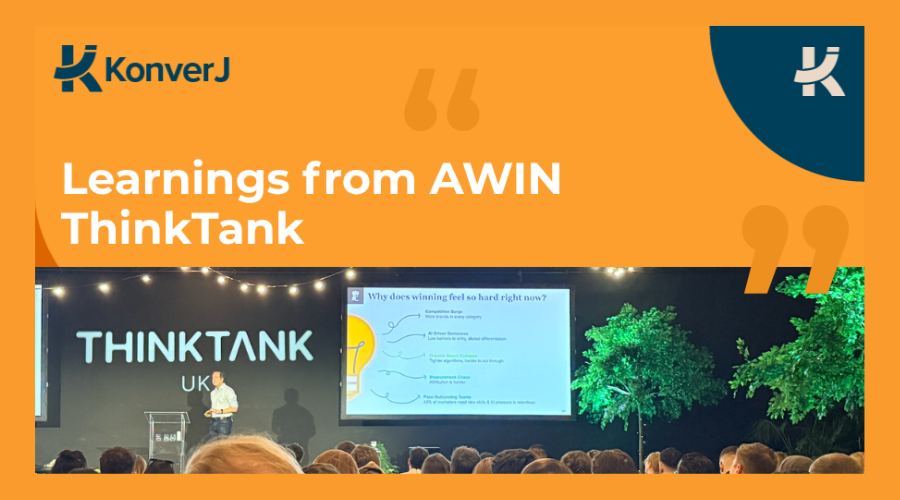
KonverJ leadership strengthens industry support as CEO Lee-Ann Johnstone joins the Performance Marketing Association’s new B2B Council. KonverJ is proud…
Read More