Launched Your Affiliate Program and Nothing’s Happening? Read This Before You Blame the Channel.
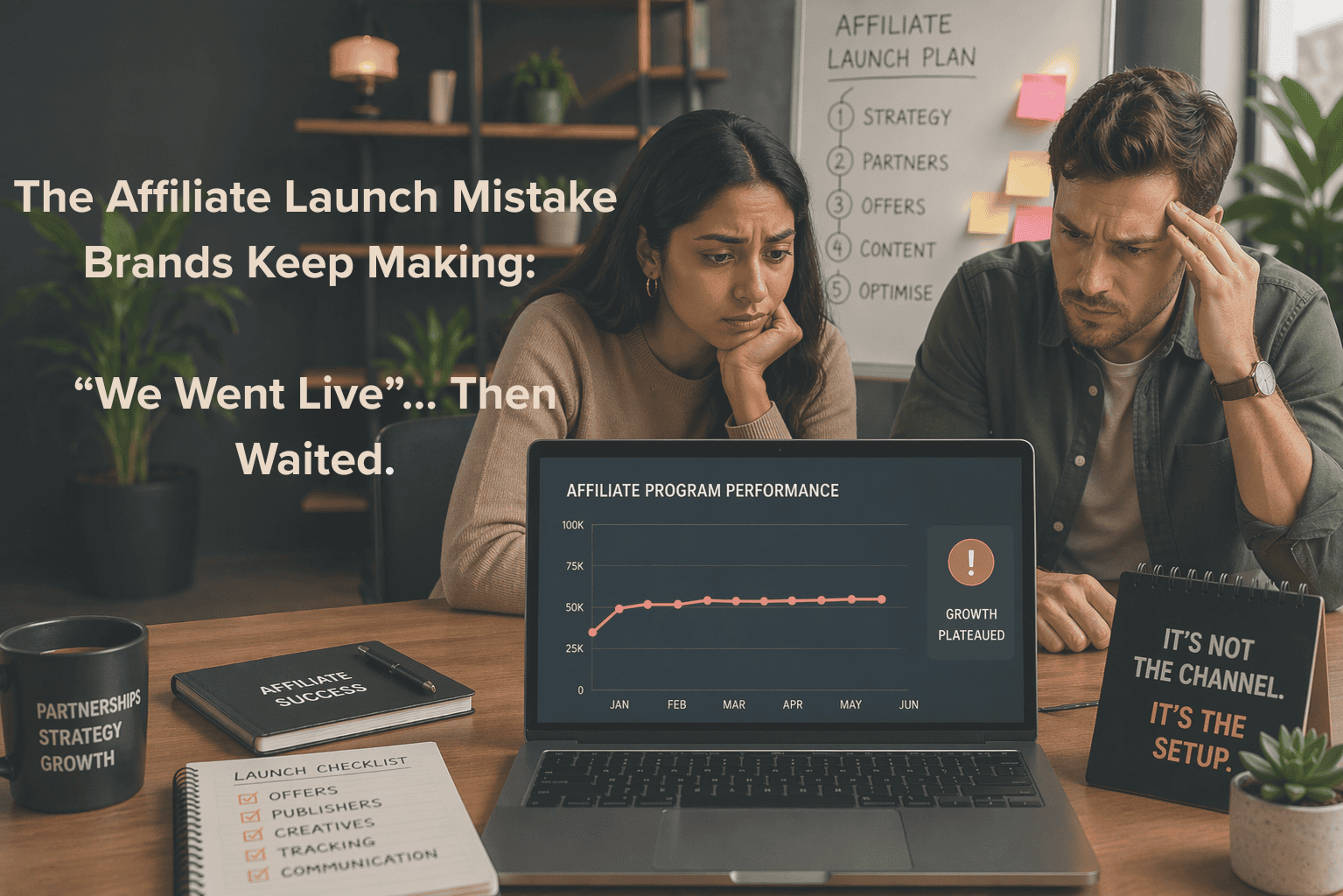
When you launch an affiliate program, the biggest mistake is thinking you have “set it up” and can now walk away.
I get why it happens. Networks and platforms can feel like a plug and play solution. You sign the contract, go live, and assume growth will follow.
But affiliate is not plug and play. It is a partnership channel. And if you do not set it up for success from day one, what you will feel in month one to three is usually the same:
- Slow burn
- Slow growth
- Frustration
- A creeping sense that affiliate “doesn’t work for us”
In most cases, it is not the channel. It is the setup.
This is the launch reality check I wish every brand had before they opened their doors to publishers.
Step one: Be clear on what your network is doing for you
Whether you are on CJ, Impact, Awin, or another network, your experience will depend heavily on the relationship and service level you have agreed to.
Some brands are self serve.
Some brands have account management.
Some brands have a more hands on support model.
The problem is not which model you are on. The problem is not knowing what you are on.
If you expect your network to recruit partners for you, pitch your program, and drive performance, but your setup is self serve, you are going to be disappointed.
If you assume the network will fix tracking, solve your attribution questions, and advise you on commission strategy, but your agreement is focused on platform access, you will stall.
Before you do anything else, ask these questions and get clear answers:
- What support do we actually have
- What does success look like in their eyes
- What do they do by default and what is optional
- What do they need from us to make anything happen
- What is the expected response time when we need help
You are not buying “affiliate growth.” You are buying access to infrastructure and a marketplace. Your growth still needs building.
Step two: Understand what “working with publishers” really means
Publishers are not sitting waiting for brands to launch.
They are running businesses. And they are inundated with programs asking them to join, share links, and promote offers.
So if your program looks like this…
- No clear offer
- No clear proposition
- No creatives
- No guidance
- No idea who you actually want to work with
…you will blend in with the noise.
The brands that win early are the ones that make it easy for publishers to say yes and easy for them to start.
That means understanding the publisher’s reality.
They want to know:
- Why should I work with you
- What is in it for my audience
- What can I promote right now
- What is exclusive or new here
- Who do I speak to if I need something
Affiliate success is not just “partners joined.” It is partners activated.
Step three: Launch with an offer, not just a listing
If you launch your program with nothing for publishers to promote, you are asking them to do the heavy lifting for you.
Your first 90 days should include a launch offer that is worth talking about.
This does not have to be complicated.
It could be:
- A launch discount
- A limited time bundle
- Free shipping or a gift with purchase
- An upgraded trial or bonus credit for SaaS
- A high converting landing page built for publisher traffic
And if you want to build early momentum with specific publishers, you should plan for publisher friendly incentives:
- Exclusive codes
- Tiered bonuses for first month performance
- Early access to a new product drop
- Category specific offers for niche partners
This is also where your network support matters because you need to know how to set these up correctly. Exclusive codes, tracking links, attribution rules, and reporting should not be an afterthought.
Step four: Choose publisher models intentionally
Not all publishers drive the same type of customer.
This is where many new programs go wrong. They either approve everyone and hope for the best, or they only chase the biggest names without a strategy.
Think about what mix fits your customer and your goals.
Here are a few simplified examples:
- Coupon and deal partners
Often attract price sensitive buyers and customers close to purchase. Great for conversion volume, but you need control so you do not train your customers to only buy on discount. - Cashback and loyalty
Can drive scale quickly and push incremental volume, especially in retail. But you must understand the true cost, the overlap with existing customers, and how you will measure incrementality. - Content and SEO publishers
Ideal for demand generation and trust building. Strong for new customer acquisition. Requires strong messaging, product angles, and assets that are easy to turn into editorial. - Influencers and creators
Great for brand led campaigns and social proof. Works best when you have a clear hook and a product that can be demonstrated. Needs fast turnaround on assets and clear tracking guidance. - B2B partners and niche communities
Often smaller but highly qualified. Perfect for SaaS and B2B. These publishers need clarity, proof, and a reason to take a bet on you.
The key is not choosing one. It is building a mix intentionally and knowing what each partner type is meant to do.
Step five: Give publishers what they need to start
This is the practical part that makes or breaks early performance.
If a publisher joins your program and then cannot find what they need, they will not chase you. They will move on.
In your first 30 days, make sure you have:
- Tracking links and guidance on how to use them
- Clear commission and validation rules
- A simple program description that actually sells the opportunity
- Creative assets in multiple sizes
- Text links and short copy options
- A launch offer clearly explained
- Contact details or a clear process for requests
You also need to know your internal process:
- How and when are you validating sales
- How do you handle returns and cancellations
- When are publishers paid
- Who responds to publisher questions and how quickly
This is not admin. This is performance.
The first 90 days: What good looks like
A good launch is not “we are live.”
A good launch is being able to say:
- We know what support we have from the network
- We have a clear launch offer and messaging
- We have a target publisher list we are actively recruiting
- We have partners activated, not just approved
- We have creatives and links that are easy to deploy
- We have a cadence for communication and optimisation
Your first three months are where you set the standard for your program.
Publishers decide early if you are serious.
And the brands that take setup seriously are the ones who avoid the slow burn and build momentum fast.
Final thought
Affiliate can absolutely be one of your most profitable channels. But it only works when you treat it like a partnership channel, not a platform you switch on.
If you are in the first 90 days of launching, focus less on “who can we recruit” and more on “are we giving partners what they need to win with us.”
Because when publishers win, you win.
If you would like our experts to help you set your program up for success, book a call with the agency team and we will help you build the right foundations, partner mix, and activation plan.
Search your own brand name right now. Not your product. Your company. There’s a real chance the top result isn’t…
Read More
Everyone who has run an affiliate program for more than a year has the same story. A ticket goes in….
Read More
Getting your affiliate or partner program live is a genuine milestone. You navigated the platform decisions, secured internal buy-in, got…
Read More