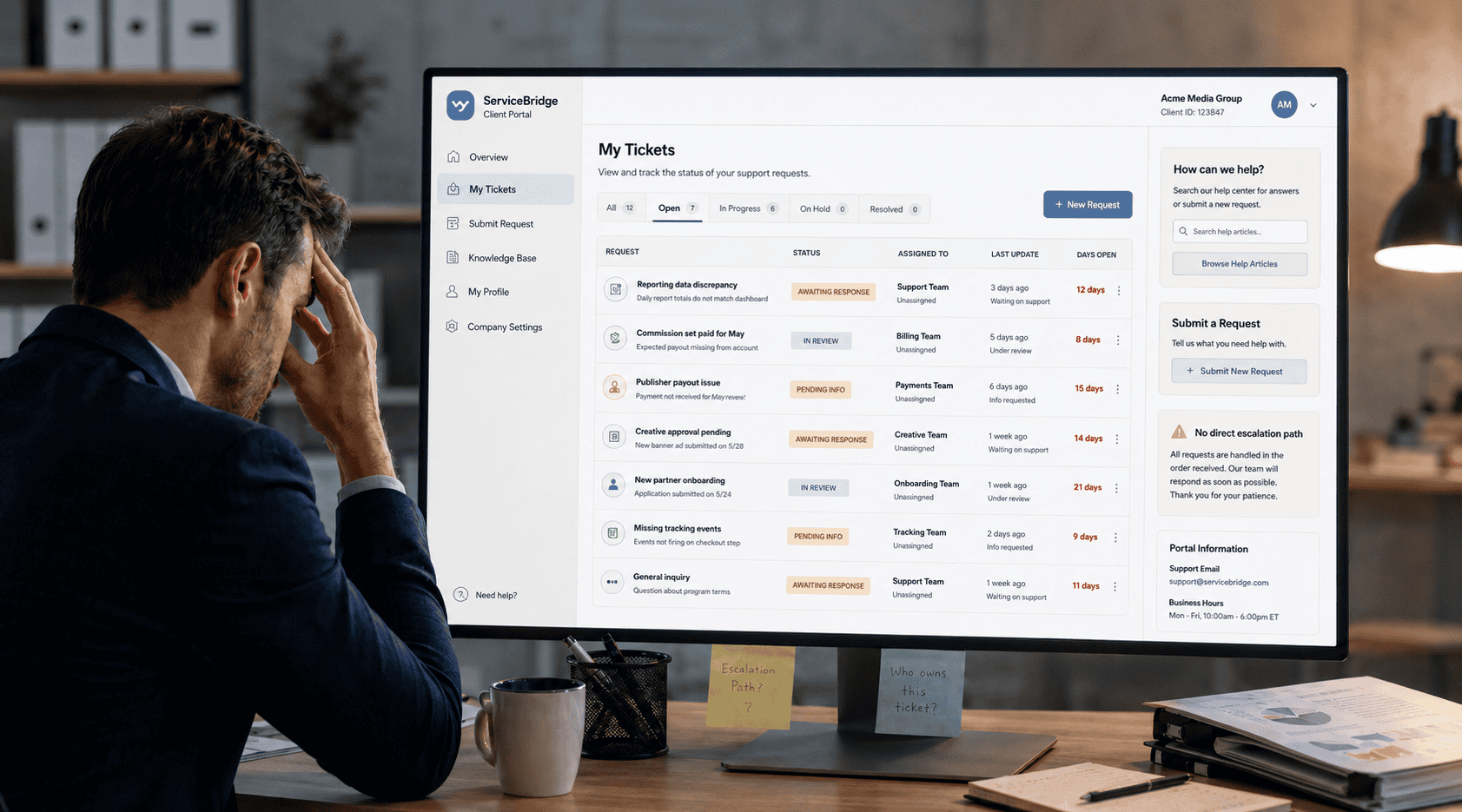
You Launched. Now You’re Stuck. Here’s What’s Actually Broken.

Getting your affiliate or partner program live is a genuine milestone. You navigated the platform decisions, secured internal buy-in, got tracking in place, signed your first partners, and hit go.
Then the launch high fades.
Suddenly, the channel that was supposed to drive consistent, scalable revenue feels more like a full-time fire to manage. Partners are joining but not converting. Recruitment bursts happen and then stall. Your reporting creates more questions than answers. And somewhere in the back of your mind, you start wondering whether the setup is actually working or whether you’ve just been busy?
If this sounds familiar, you are not experiencing failure. You are experiencing the post-launch dip that almost nobody warns you about, and it has very clear patterns.
The Problem Is Not the Channel. It’s the Missing Operating Rhythm.
Most programs do not plateau because affiliate marketing does not work. They plateau because the operating structure that was supposed to sustain growth never got built properly in the first place.
The launch phase demands a sprint mentality: everything is urgent, everything is new, and adrenaline covers the gaps. But the moment the program goes live, the sprint becomes a marathon, and the gaps become visible.
Here are the six most common post-launch problems we see across programs at every stage of maturity.
Partners are joining but not activating. Sign-ups look healthy on paper, but the actual output is thin. This almost always comes down to a weak onboarding structure. If a new partner has no clear pathway to their first conversion in the first 30 days, most will go quiet. A structured activation journey is not optional, it is the difference between a growing program and one that is coasting on sign-up volume.
Recruitment is inconsistent. You do a focused outreach push, see momentum, then your team gets pulled onto other priorities and the pipeline dries up. Without a weekly recruitment cadence and a follow-up system, partner acquisition becomes reactive. Our partner discovery and recruitment service exists specifically to solve this, because consistent recruitment requires dedicated process, not periodic effort.
Reporting is generating debates instead of decisions. Stakeholders ask questions you cannot answer quickly. That usually means your tracking rules are unclear, your commission attribution lacks transparency, or you are reporting volume metrics to an audience that needs performance metrics. If your data is prompting arguments rather than action, the reporting infrastructure needs attention before the team loses confidence in the channel entirely.
The program is reactive, not proactive. You spend your time responding to individual partner requests rather than shaping performance across the network. This happens when there is no monthly plan, no partner enablement pack, and no clear segmentation between your top performers and your long tail. Effective affiliate program management requires a proactive posture, it is not a support desk.
The proposition is unclear or generic. Partners who do not immediately understand why your program is worth promoting will not promote it. If your commission structure, creative assets, and value messaging were set up quickly at launch and never refined, you are competing for partner attention with weaker tools than you should have.
Resourcing is stretched. In-house teams wear too many hats. The affiliate program becomes one of several priorities rather than a managed growth channel, and the lack of dedicated attention compounds every other problem on this list.
What Elevation Actually Means
There is a point in every program’s life where launch activity has to become a repeatable system. That transition is what we call elevation, and it is built on three things.
A clear partner mix that matches your commercial objective. Not all partners are equal, and the mix that got you through launch is rarely the one that will take you to scale. Your partner strategy should be intentional, not just a reflection of who applied.
An activation engine that converts sign-ups into consistent output. This means structured onboarding, defined milestones, clear enablement materials, and regular communication that gives partners what they need to perform.
A rhythm that keeps the program moving even when the team is under pressure. Weekly recruitment cadences, monthly performance reviews, structured partner communications, these are not administrative luxuries. They are the operating infrastructure of a program that grows.
Most plateaus come down to weakness in one of these three areas. The challenge is that they can look identical on the surface, which is why diagnosing the actual cause matters more than applying a generic fix.
How to Diagnose Before You Hire
The temptation when a program is underperforming is to add resource. More headcount, more budget, more partners. Sometimes that is the right answer. Often it is not.
Before expanding anything, it is worth asking five diagnostic questions:
Is your partner mix actually aligned to your growth stage? Early-stage programs often over-index on voucher and cashback partners because they are easy to recruit. They generate volume but rarely margin. If your mix does not include content, comparison, and niche vertical partners, you have a mix problem.
Where is the activation gap? Look at the ratio of signed partners to active partners. If a significant portion of your network has never generated a transaction, the issue is in onboarding and enablement, not recruitment.
Is your offer competitive? Commission structures and promotional terms that made sense at launch may now be out of step with the market. Regularly measuring your ROI and reviewing commission structures is one of the most practical ways to keep your program competitive without guessing.
Do you trust your tracking data? Reporting confidence directly affects how decisions get made. If stakeholders do not trust the numbers, they will not invest in the channel. Tracking integrity is a technical foundation issue and should be treated as one. Our technical integration service addresses exactly this kind of problem.
Is this a strategy problem or a resourcing problem? These are different diagnoses with different solutions. Throwing more management hours at a strategy problem will not fix it. Running a comprehensive affiliate program audit is often the fastest way to tell them apart.
Three Ways to Elevate Without Defaulting to Full Outsourcing
Not every program needs a fully managed agency relationship. Sometimes a targeted intervention is what unlocks growth. Here are the three most effective models we see.
Fix foundations in-house. If the diagnosis points to a structural gap – weak onboarding, unclear tracking, no recruitment cadence, you can address these internally with the right prioritisation. Use a 30-day sprint framework: week one to tighten your partner proposition and target partner mix, week two to build an activation journey and partner enablement pack, week three to run recruitment with disciplined follow-up, and week four to review performance and reallocate attention based on what is actually working.
Bring in specialist support for a specific workstream. If recruitment is the bottleneck but management is fine, a targeted recruitment engagement makes more sense than full program management. If tracking is the issue, technical consulting solves it more efficiently than a broader retainer. Our agency services are designed to be modular for exactly this reason.
Audit first, then decide. If you are not sure whether you have a strategy problem or a resourcing problem, a comprehensive audit removes the guesswork. Our program audits are designed to answer three questions: what is the fastest path to unlock growth, what should you stop doing, and what should you focus on in the next 90 days. It is the most efficient starting point for any program that has plateaued without a clear cause.
We have worked with programs across e-commerce, B2B SaaS, and iGaming where the audit findings were genuinely surprising to the internal team. What looked like a recruitment problem turned out to be a proposition problem. What looked like a management bandwidth issue turned out to be a tracking confidence problem that was killing internal investment. Diagnosis first, intervention second, that sequence matters.
Actionable Takeaways for Affiliate Managers
1. Run a partner activation audit this week. Pull your full partner list and separate signed partners from active partners. If the gap is significant, your activation journey is where the growth is hidden – not in recruiting more partners. Fixing what you have is almost always faster than adding to it.
2. Build your operating rhythm before you scale. A weekly recruitment cadence, a monthly performance review, and a structured partner communication calendar are not bureaucratic overhead. They are the scaffolding that allows a program to grow without depending on heroic individual effort. If these do not exist yet, building them is your highest-leverage activity.
3. Diagnose before you spend. Whether you are considering bringing in external support, expanding your partner base, or increasing promotional budgets, run the five diagnostic questions above first. Understanding whether you have a strategy problem or a resourcing problem will save you time, money, and a significant amount of frustration. If the answer is not clear, a program audit will surface it.
Launching is genuinely hard. The teams who get through it deserve credit for what they have built. But elevation requires something different from launch: not more urgency, but more structure. Not more partners, but better activation. Not more reporting, but clearer decisions.
If your program is live and not performing the way it should, the most important thing is to diagnose accurately before you act. The fixes are usually more targeted than they appear.
Explore our full range of agency services or review additional case studies demonstrating how strategic intervention drives results across verticals. Book a call with our agency team today.
The outcome you want in your affiliate programme should determine everything from your partner strategy, to your budget and your…
Read More
Search your own brand name right now. Not your product. Your company. There’s a real chance the top result isn’t…
Read More
Everyone who has run an affiliate program for more than a year has the same story. A ticket goes in….
Read More