What Affiliates Promoting EdTech Should Know for 2026 and Beyond

The Learning Management System has been the backbone of corporate training for two decades. Now, according to new industry research, fewer than half of learning professionals believe it will retain that central position over the next three years.
Synthesia’s AI in Learning & Development Report 2026, surveying 421 L&D professionals globally, found that only 47% agree the LMS will remain the backbone of their learning ecosystem by 2028. The rest are either neutral, expect the centre of gravity to shift elsewhere, or simply don’t know yet.
For affiliates promoting educational technology platforms whether LMS solutions, AI learning tools, or productivity software with training features this uncertainty signals both disruption and opportunity.
The Confidence Crisis in Enterprise Learning Platforms
The LMS emerged in the 1990s to solve specific problems: tracking compliance training, delivering standardised content, and managing learner records at scale. For many organisations, it still performs those functions adequately.
But adequacy isn’t inspiring confidence. The report’s finding that 53% of learning professionals either disagree, remain neutral, or are uncertain about the LMS’s future relevance suggests a market questioning whether yesterday’s solutions fit tomorrow’s needs.
Kristen Budd, a learning experience designer quoted in the report, framed the shift bluntly: “The LMS was built for a world that no longer exists. It solved the problems of compliance and content delivery twenty years ago, but learning has moved far beyond that. Today’s learners expect experiences that are fluid, personalised, and AI-powered, not static course catalogues.”
This isn’t a hypothetical future concern. It’s a present-tense reassessment of technology investments that often run into six or seven figures annually for enterprise organisations.
Where Learning Professionals Expect AI to Live
If not the LMS, then where? The report asked where respondents expect AI capabilities to primarily live in their learning ecosystem. The responses split almost evenly across four possibilities:
- Embedded in the LMS or learning experience platform: 19%
- Embedded in productivity tools (Microsoft 365, Google Workspace): 17%
- Delivered through standalone AI platforms: 17%
- Operating as cross-system agentic layers: 19%
The largest single group, at 27%, answered that they simply don’t know yet.
This distribution tells a story of market uncertainty. There’s no consensus view on which architecture will win. Productivity suite vendors, standalone AI platforms, traditional LMS providers, and emerging agentic AI players all have plausible paths to capturing this market—and learning professionals haven’t decided which bet to make.
Kevin Alster, Strategic Advisor at Synthesia, captured the dynamic: “L&D is entering a new ‘AI-integrated’ era where the real question isn’t which tools to use but how to build a learning ecosystem that drives performance.“
The Redistribution, Not Replacement, Pattern
The report’s authors are careful to note that the picture emerging isn’t one of LMS replacement but of redistribution. The LMS is becoming one component in a wider, more connected ecosystem rather than the central hub everything flows through.
Data and AI-driven services are moving more freely across tools. Teams are shifting from point solutions to composable, multi-model AI stacks layered on general-purpose AI. The learning platform of the future may look less like a monolithic system and more like an integration layer connecting multiple specialised tools.
This has significant implications for how affiliates should think about the EdTech market. Promoting a single platform as “the solution” may become less compelling than promoting integration-ready tools that work within a broader ecosystem.
The SaaS Affiliate Opportunity in Uncertain Markets
Market uncertainty creates affiliate opportunity. When buyers don’t know which platforms will win, they research more extensively, consume more content, and rely more heavily on trusted recommendations to guide their decisions.
The SaaS affiliate landscape has always rewarded affiliates who can cut through confusion. As one industry analysis noted, software users today rely heavily on social proof before purchasing—they research, consult trusted publications, and check with influencers who share reviews and tutorials.
For affiliates in the EdTech space specifically, the LMS uncertainty creates several content opportunities.
Comparison content becomes more valuable. When the market fragments across multiple platform types, buyers need help understanding the differences between embedded LMS AI, standalone AI platforms, productivity suite integrations, and agentic learning systems. Affiliates who can clearly explain these distinctions serve a genuine need.
Integration-focused reviews gain relevance. If the future is ecosystem-based rather than platform-based, reviews that assess how well tools integrate with existing infrastructure become more important than standalone feature comparisons.
Use-case specific guidance helps buyers navigate. A compliance-heavy organisation has different needs than an innovation-focused technology company. Content that matches platform capabilities to specific organisational contexts helps buyers find appropriate solutions.
The Emerging Platform Categories to Watch
The report’s data suggests four platform categories competing for the next generation of learning infrastructure investment.
Enhanced LMS platforms are the incumbent defenders. Companies like Cornerstone, Docebo, and Absorb are racing to embed AI capabilities into their existing platforms. The 19% who expect AI to live embedded in the LMS or LXP represent their addressable market. For affiliates, these programs offer the advantage of established brands with existing customer bases seeking upgrades.
Productivity suite AI represents the stealth competitor. Microsoft’s Copilot integration across 365 applications and Google’s Gemini embedding in Workspace mean that AI learning capabilities may arrive through tools organisations already pay for. The 17% expecting AI to live in productivity tools signals potential demand erosion for standalone learning platforms.
Standalone AI platforms are the specialist challengers. Platforms like Synthesia (for video), ChatGPT Enterprise, and purpose-built AI learning tools compete on capability depth. The 17% expecting standalone AI platforms to lead suggests a market for best-of-breed solutions that outperform embedded alternatives. Many of these platforms offer attractive affiliate commission structures, with recurring revenue models that can build substantial income over time.
Agentic AI layers represent the most forward-looking category. The 19% expecting cross-system agentic layers – AI that can autonomously take actions across multiple platforms – points toward an emerging architecture that barely exists today. Early movers in this space include companies building AI agents for enterprise workflows. For affiliates, this category offers first-mover positioning but carries higher risk given the technology’s immaturity.
The Budget Reality Check
Market uncertainty doesn’t always translate into increased spending. The report found that AI investment in L&D remains modest and often unclear.
39% of respondents allocate just 1-5% of their L&D budget to AI, while 15% allocate 6-10%. Notably, 30% don’t know their AI spend at all, suggesting activity is scattered rather than strategically planned.
However, trajectories are shifting. Over the next 12-18 months, the share expecting to spend nothing on AI drops from 13% to just 5%, while more teams anticipate moving into double-digit investment.
For affiliates, this signals a market that’s committed to AI adoption but still in early spending stages. The opportunity lies less in immediate high-volume transactions and more in positioning for the spend increase that’s clearly coming. Content that builds trust now will convert when budgets mature.
Blockers That Represent Content Opportunities
The report identified specific concerns slowing AI platform adoption – each representing a potential content angle for affiliates.
- Security concerns affect 58% of respondents. Affiliates promoting platforms with strong security credentials, compliance certifications, and enterprise-grade data protection can address a documented barrier.
- Accuracy concerns impact 52%. Tools that can demonstrate reliability, offer human-in-the-loop review capabilities, or provide quality assurance features address a real worry.
- Integration challenges affect 46%. Platforms that emphasise easy connectivity with existing systems – including legacy LMS infrastructure – speak to a significant pain point.
- Legal constraints concern 41%. Solutions designed with regulatory compliance in mind, particularly around data privacy and AI governance, address legitimate enterprise needs.
Content that directly addresses these blockers – not just feature comparisons but substantive analysis of how platforms handle security, accuracy, integration, and compliance – serves buyers genuinely wrestling with these concerns.
What This Means for EdTech Affiliate Strategy
The LMS disruption data suggests several strategic adjustments for affiliates promoting educational technology.
Diversify across platform categories. Rather than betting exclusively on traditional LMS programs, consider building positions across enhanced LMS platforms, standalone AI tools, and emerging agentic solutions. Market uncertainty favours affiliates with diversified portfolios.
Lead with integration and ecosystem thinking. Content that helps buyers understand how tools fit together – rather than which single platform to choose – aligns with how the market is actually evolving.
Address blockers directly. Security, accuracy, integration, and compliance concerns represent real barriers. Affiliates who can credibly address these issues in their content build trust with enterprise buyers.
Position for budget maturation. Current AI learning budgets are modest, but trajectories point toward significant growth. Content that establishes authority now will convert when spending accelerates.
Watch the productivity suite threat. If Microsoft and Google embed sufficient AI learning capabilities into their existing platforms, demand for standalone tools could compress. Affiliates should monitor this competitive dynamic carefully.
The Bigger Picture for Affiliate Marketers
The learning technology market’s uncertainty mirrors dynamics playing out across enterprise software. AI is forcing reassessment of entrenched platforms, creating windows of opportunity for new entrants while threatening incumbents who fail to adapt.
For affiliates, market transitions like this represent prime opportunity – but only for those who understand the underlying dynamics well enough to guide buyers through complexity.
As the broader affiliate marketing landscape evolves with AI integration, affiliates who can demonstrate genuine expertise in navigating platform uncertainty will differentiate themselves from those simply promoting whatever pays the highest commission.
The 53% of learning professionals who aren’t confident in their LMS’s future are actively seeking guidance. Affiliates who provide it will capture attention – and conversions – as this market reshapes itself over the coming years.
KonverJ’ agency team has been fully certified with Webgains, a leading UK affiliate network, strengthening its knowledge of the network,…
Read More
Affiliate Does More Than Win the Last Click Last week we attended Awin ThinkTank UK 2026. It was an interesting…
Read More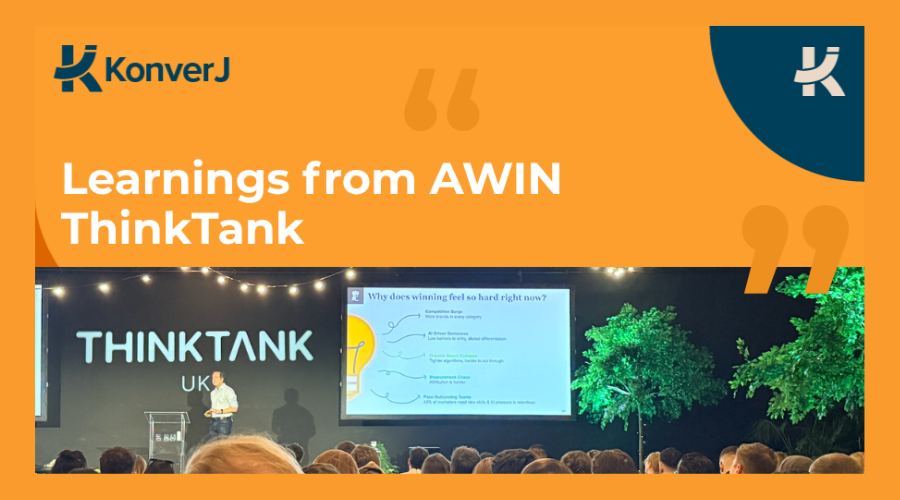
KonverJ leadership strengthens industry support as CEO Lee-Ann Johnstone joins the Performance Marketing Association’s new B2B Council. KonverJ is proud…
Read More