Five Channels Affiliates Should Pay Attention to in 2026
The affiliate marketing industry is approaching a $20 billion global valuation in 2026, but the channel barely resembles what it was even two years ago. Consumer attention has fragmented across platforms, AI is reshaping discovery, and traditional search dependency is becoming a liability rather than a strategy.
For affiliates planning where to invest time and resources this year, the question is no longer simply “where is the traffic?” but rather “where does purchase intent actually convert?”. These five channels represent the most significant opportunities for affiliates who want to build sustainable revenue streams rather than chase diminishing returns from oversaturated platforms.
1. TikTok Shop: Social Commerce at Scale
TikTok has evolved from entertainment platform to full commerce ecosystem, and affiliates who haven’t adapted their strategies are already falling behind. The platform’s $100 million single day Black Friday performance demonstrated that social shopping isn’t experimental anymore: it’s a primary revenue channel.
What makes TikTok Shop particularly compelling for affiliates is the compressed purchase funnel. Discovery, consideration, and purchase now happen in seconds within the same platform. Users spend an average of 58.4 minutes daily on the app, creating multiple touchpoints for affiliate exposure, and internal data suggests that 92% of users take action after watching TikTok videos.
The platform maintains a 5.2% affiliate link engagement rate, significantly higher than Instagram’s 2.0% or YouTube’s 0.2%. For affiliates working in fashion, beauty, home goods, or lifestyle niches, TikTok’s affiliate program offers direct commission opportunities without requiring external redirects that historically killed conversion rates.
CJ Affiliate’s TikTok influencer program integration has addressed one of the channel’s previous limitations: fragmented tracking. Publishers can now track TikTok Shop commissions alongside Amazon Associates earnings and direct brand partnerships within consolidated reporting dashboards.
The strategic consideration for 2026 is content format. Hard selling doesn’t work here. Affiliates succeeding on TikTok are creating “edutainment” content: product demonstrations, behind the scenes clips, and genuine recommendations that feel like advice from a friend rather than promotional material. The platform’s algorithm favours authenticity, and UGC style content consistently outperforms polished, overly produced alternatives.
2. YouTube Shopping: Long Form Trust Building
While TikTok wins on engagement metrics, YouTube dominates in conversion value and long term revenue potential. YouTube affiliate marketing generated over $2.6 billion globally in 2024, with year over year growth of 31%. The platform commands the highest average cart value at $84, compared to Instagram’s $61 and TikTok’s $57.
YouTube’s Shopping Affiliate program has evolved from experimental feature to legitimate commerce channel capable of driving substantial revenue. The platform’s approach combines authentic creator content with direct commerce functionality in ways that other platforms struggle to replicate.
Review style videos achieve 4.1% conversion rates, while the platform average sits at 3.2%. The difference reflects YouTube’s fundamental strength: extended viewing time and detailed product explanation formats build trust that converts differently than Instagram’s visual browsing or TikTok’s entertainment first approach.
For affiliates, the YouTube Affiliate Hub integrates directly with the platform, allowing creators to select products, access promotional assets, and track commissions in one place. Geographic restrictions currently limit participation to the US and Korea, but expansion is expected throughout 2026.
The strategic play is combining formats. Long form builds trust through detailed tutorials and comprehensive reviews while YouTube Shorts drives immediate action and captures attention for channel growth. Successful programs support creators across both formats with product samples, production lead time, and technical support for shoppable features.
3. Pinterest: Visual Discovery Meets Performance Marketing
Pinterest has long occupied an awkward position in affiliate strategies: excellent for awareness, challenging for attribution. That’s changing rapidly, and affiliates who dismissed the platform as upper funnel only need to reconsider.
The platform functions more like a visual search engine than a social network. Users come with intent, often searching for specific ideas, products, or inspiration. According to Pinterest’s own data, 80% of weekly pinners have discovered a new brand or product on the platform. This intent driven traffic is valuable because users are frequently in a buying mindset.
Pinterest’s recent acquisition of tvScientific signals strategic evolution toward genuine performance marketing capability. The deal integrates tvScientific’s outcome based connected television capabilities directly into Pinterest’s Performance+ suite, combining the platform’s 600 million monthly active users with deterministic attribution across 95% of ad supported streaming inventory.
For affiliates, this development raises the platform’s potential from inspiration to measurable conversion channel. Pins drive traffic months or years after publication through organic discovery, creating evergreen revenue streams that contrast sharply with the ephemeral nature of TikTok or Instagram content.
The platform excels in specific niches where aesthetics matter: home décor, fashion, beauty, fitness, and DIY. Pinterest’s affiliate marketing approach requires SEO thinking since the algorithm is heavily driven by keywords and searchability. Affiliates should focus on creating pins and boards rich in relevant keywords, optimising for the platform’s search engine characteristics rather than treating it as another social feed.
4. AI and Conversational Commerce: The Emerging Battleground
The most significant channel shift in 2026 isn’t a social platform: it’s AI mediated commerce. ChatGPT surpassed 700 million weekly active users in August 2025, and a significant portion of queries relate to shopping and product research. The question isn’t whether AI will transform affiliate marketing. It already has.
However, affiliates should approach this channel with strategic clarity rather than panic. Recent research analysing 973 e-commerce sites found that ChatGPT referrals underperform virtually every traditional channel across key financial metrics. Affiliate links convert 86% more often than ChatGPT referrals. Organic search outperforms ChatGPT by roughly 13%.
The real opportunity isn’t traffic from AI platforms: it’s citation positioning. When ChatGPT recommends products or answers shopping queries, which brands get mentioned matters enormously, even if those mentions don’t immediately convert. Users engage in verification behaviour, using ChatGPT for discovery then searching the recommended brands directly. Being cited by AI becomes upper funnel brand awareness that traditional attribution models can’t capture.
OpenAI’s Instant Checkout feature allows purchases to complete entirely within ChatGPT, creating attribution challenges for traditional affiliate tracking. The platform takes transaction fees, establishing direct revenue streams from commerce that occurs outside traditional infrastructure.
For affiliates, the strategic response is building genuine content authority that AI models cite as trusted sources. Digital PR, earned media coverage, and authentic reviews from industry publications matter more than ever because LLMs prioritise content from credible sources. The brands and publishers with strong pre existing recognition receive more positive mentions in AI responses.
5. Podcasting: The B2B Performance Marketing Revolution
There’s a quiet revolution happening in performance marketing, and it’s coming through earbuds. While affiliate managers scramble to crack the code on LinkedIn ads and Google Search optimisation, 584 million people globally are spending 7+ hours per week consuming podcast content. More importantly, they’re not just listening: they’re acting.
The numbers backing podcast advertising as a performance channel are quite remarkable. Nielsen’s 2024 research shows podcast ads achieve a 71% brand recall rate. Traditional television advertising averages 32.5%. Prime podcast users who listen daily demonstrate an 86% ad recall rate, the highest of any media channel studied.
The attribution objection that previously deterred affiliate investment has been largely resolved. Pixel based attribution providers, custom landing pages, unique promo codes, and post purchase surveys now provide multiple verification points. According to Podscribe’s benchmarking data, 5 to 10% of listeners who visit a site after hearing a podcast ad make a purchase.
For B2B affiliates specifically, podcasting offers access to decision makers in contexts where they’re receptive to recommendations. The channel’s intimate, trust building nature delivers audiences with purchasing authority who engage deeply with content rather than scrolling past it.
The tactical approach is identifying 10 to 15 podcasts in your vertical with engaged audiences and reaching out with partnership proposals that emphasise revenue share over flat sponsorship fees. The creators building subscription revenue around in depth analysis have different content incentives than those dependent on sponsorships, and affiliate partnerships can complement rather than compete with their existing monetisation.
Strategic Considerations for 2026
The trends reshaping affiliate marketing in 2026 share a common thread: the balance of power continues shifting toward creators with engaged audiences rather than traditional publishers. Platform diversification is no longer optional since relying on a single channel creates unacceptable concentration risk.
The most successful affiliates in 2026 won’t be those who master every platform. They’ll be those who deeply understand their chosen channels, develop authentic audience relationships, and consistently deliver value that builds trust over time. YouTube captures 70% of affiliate driven video consumption while short form content on TikTok and Instagram Reels drives immediate action. The strategic question is which formats and platforms align with your content strengths and audience expectations.
For affiliates evaluating where to focus, consider the intersection of three factors: where your target audience actually spends time, which platforms support your content creation capabilities, and where measurement infrastructure allows you to prove value to brand partners.
The channel’s projected growth to $180 billion by 2028 rewards programs that thoughtfully integrate emerging opportunities while maintaining focus on fundamental relationship building. The traffic isn’t disappearing: it’s redistributing across more platforms with more sophisticated commerce capabilities than traditional affiliate models were designed to capture.
Adapting to that reality isn’t optional. It’s the price of remaining relevant in an industry that rewards those who move with consumer attention rather than against it.
KonverJ’ agency team has been fully certified with Webgains, a leading UK affiliate network, strengthening its knowledge of the network,…
Read More
Affiliate Does More Than Win the Last Click Last week we attended Awin ThinkTank UK 2026. It was an interesting…
Read More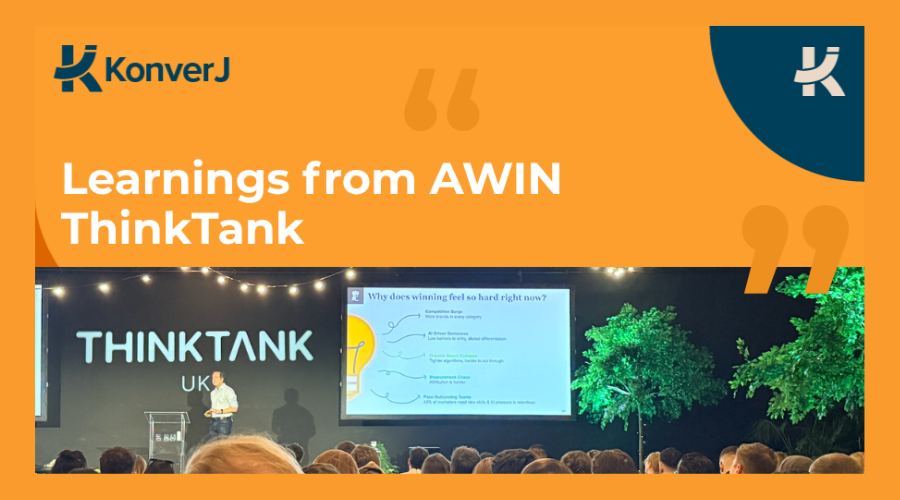
KonverJ leadership strengthens industry support as CEO Lee-Ann Johnstone joins the Performance Marketing Association’s new B2B Council. KonverJ is proud…
Read More