Black Friday Fatigue? Mid-Funnel Partners Own the Weekend After
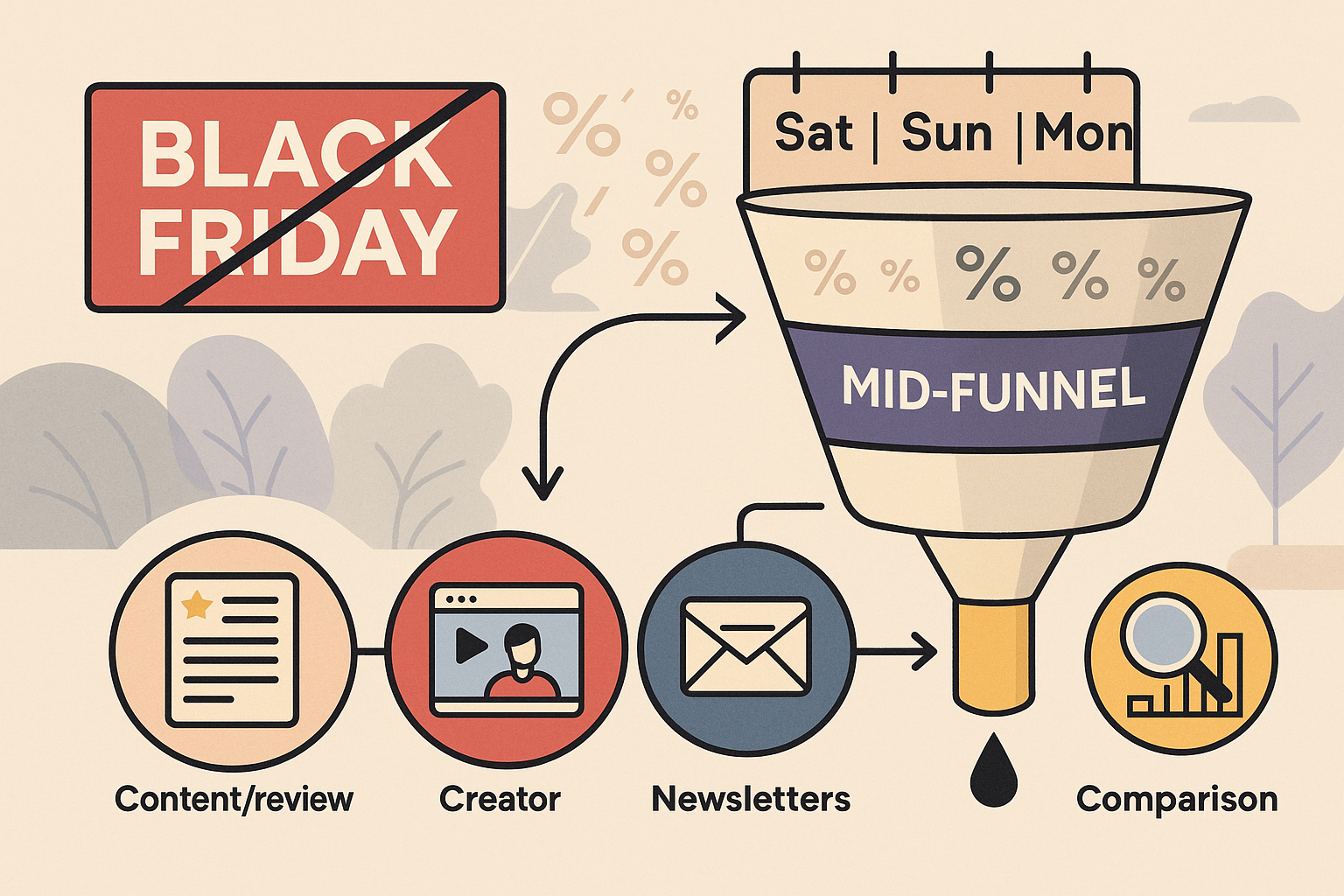
The email subject lines tell the story: “ENDS TONIGHT.” “FINAL HOURS.” “LAST CHANCE.” By Friday evening, discount-heavy messaging has saturated every channel, and the shoppers still browsing haven’t converted for a reason. They’re comparing, deliberating, and seeking reassurance before they buy.
That’s precisely when mid-funnel affiliate partners deliver their strongest returns.
Industry chatter consistently points to the same pattern: peak traffic dynamics extend well beyond Black Friday itself. Yet many brands continue to over-index their entire promotional budget and partner activation on a single 24-hour window, leaving substantial revenue on the table during the critical 72 hours that follow.
The Post-Peak Window: Saturday Through Monday
When discount urgency fades, a different buying psychology takes over. Shoppers who resisted Friday’s noise return with clearer intent but lingering questions. They want proof that what they’re about to purchase is the right choice, not just the cheapest one.
This is where content partners, creator-as-affiliate models, price comparison engines, and newsletter placements consistently outperform during the weekend after Black Friday. While last-click voucher affiliates dominate Friday traffic, mid-funnel partners convert the undecided through comparison content, product demonstrations, and editorial endorsement precisely when buyers are actively researching.
The mechanics are straightforward: cost-per-click rates normalise after Friday’s bidding frenzy, attention rebounds as inbox saturation decreases, and shoppers shift from impulse mode to evaluation mode. Brands that recognise this pattern and activate the right partners see conversion rates improve while blended customer acquisition costs often drop below Black Friday benchmarks.
Why Mid-Funnel Partners Convert Weekend Browsers
Traditional affiliate strategies prioritise last-click attribution, which naturally favors voucher sites and deal aggregators during high-urgency promotional windows. But attribution models that ignore assisted conversions systematically undervalue the partners who drive consideration during extended promotional periods.
Content publishers running gift guides, comparison articles, and category round-ups generate traffic throughout the weekend as shoppers research purchases they didn’t make on Friday. Creator-as-affiliate partnerships deliver product demonstrations and authentic recommendations that build confidence for fence-sitters. Email newsletters reach audiences on Saturday and Sunday mornings when inbox competition has decreased and readers have time to engage with editorial content.
Price comparison CSS (Comparison Shopping Services) windows present another overlooked opportunity. When Google Shopping CPCs normalise post-peak, comparison affiliates can bid more efficiently on product categories where demand remains strong but competition has eased. This creates a brief arbitrage window for brands working with CSS partners who understand post-peak bidding dynamics.
From our work managing programs across e-commerce, iGaming, and B2B SaaS verticals, we’ve observed this pattern repeatedly: the brands that perform best during Cyber Weekend understand that Black Friday is the starting gun, not the finish line. They’ve briefed their content and creator partners weeks in advance, supplied evergreen promotional assets, and given these partners permission to run through Monday without requiring fresh discount codes every 24 hours.
Three Tactical Plays for the 72-Hour Post-Peak Window
Activate Content Partners With Evergreen Assets
Content affiliates need promotional materials that maintain relevance beyond Friday. Gift guides, category comparisons, and “best of” editorial content perform throughout the weekend, but only if partners receive creative assets and product information early enough to build quality content. Brands that supply high-resolution imagery, detailed product specifications, and flexible promotional messaging weeks before Black Friday enable content partners to publish during the weekend when research traffic peaks.
The execution is simple: brief your content affiliate segment by early November with evergreen creative, extended promotional windows (Friday through Monday at minimum), and clear guidance on messaging that emphasises product benefits rather than time-limited urgency. Then ensure these partners have visibility in your Friday through Monday email sequences to affiliate networks, so they know the promotion continues.
Deploy Creator-as-Affiliate for Weekend Product Demonstrations
Shoppers scrolling Instagram or TikTok on Saturday morning aren’t looking for another “FINAL HOURS” discount code. They’re looking for reassurance that the product they’re considering actually works. Creators demonstrating products in real-world contexts convert these browsers more effectively than display ads repeating Friday’s urgency messaging.
Brief your creator affiliates to schedule content for Saturday and Sunday publication, when platform algorithms favour organic reach and audiences have time to watch longer-form content. Provide creators with talking points focused on product functionality, quality, and use cases rather than scripted discount announcements. The most effective creator-as-affiliate activations during this window feel like genuine recommendations, not sponsored urgency.
Leverage CSS Partners When CPCs Normalise
If you work with comparison shopping affiliates, brief them to increase bidding activity from Saturday morning through Monday. Google Shopping CPCs typically spike on Thursday and Friday, then drop as brand budgets exhaust and competition decreases. CSS partners who understand this pattern can win placements at lower cost during the weekend, capturing shoppers who are still comparing options but face less bidding competition.
The technical requirement: ensure your product feed updates reflect current promotional pricing through Monday, and confirm your CSS partners have budget allocated for weekend bidding. Many brands pause comparison shopping activity after Friday, creating opportunity for those who don’t.
The Seven-Day Post-Peak Activation Plan
Strategic affiliate programs don’t end their promotional calendar on Black Friday. Here’s the tactical timeline that captures weekend revenue:
Three Weeks Before Black Friday: Content partners and creators should already have evergreen creative assets, extended promotional windows, and messaging focused on product benefits rather than time-limited urgency. High-resolution imagery, detailed specifications, and flexible promotional copy need to be in their hands with enough runway to build quality content. Waiting until the week before Black Friday means your content partners can’t produce the editorial pieces that convert weekend browsers.
48 Hours Before Black Friday: Your launch communication to all affiliate segments should be finalised and ready to deploy, with specific weekend activation guidance already embedded for content partners, creators, and CSS affiliates. The promotional window continuation through Monday should be crystal clear, not an afterthought added on Friday morning.
Black Friday Morning: Monitoring systems need to be in place to track which partner segments are driving conversions throughout the day. Your Saturday outreach preparation for mid-funnel segments should be ready to execute, not scrambled together while you’re analysing Friday’s performance.
Saturday Morning: Targeted communication to content affiliates and creators reminding them the promotional window remains active should be deployed early, ideally before 9am. Early Friday performance data demonstrating continued demand needs to be ready to share. For CSS partners, weekend bidding budget confirmations should already be sorted, not chased down on Saturday afternoon.
Sunday Morning: Editorial-focused assets for newsletter affiliates should be available for their Monday morning sends, with enough time for them to build their campaigns. Content partners need to understand that Monday represents the final high-traffic day before Cyber Monday shifts promotional focus, creating natural urgency without requiring new discount codes.
Monday Morning: Final push communication emphasising this is the last day before Cyber Monday promotional shifts should be live early. All partner segments need to know that strong weekend performance typically continues through Monday morning, but the window is closing.
Tuesday Morning: 72-hour post-peak performance data review by partner segment should be scheduled and executed. Identifying which content partners, creators, and CSS affiliates delivered strong weekend conversions needs to happen while the data is fresh. This intelligence directly informs Cyber Monday activation and next year’s planning, so delaying this analysis until the following week means missed opportunities.
The common thread: preparation dictates performance. Brands that scramble to brief partners on Friday miss the post-peak window entirely. Your content affiliates can’t produce quality comparison content overnight. Your creators can’t film, edit, and schedule product demonstrations while Black Friday is already underway. Your CSS partners can’t optimise weekend bidding if they learn about the extended window after Friday closes.
For more detailed guidance on seasonal affiliate program optimisation, review our Black Friday affiliate strategies or explore our approach to affiliate program management across promotional periods. Our team has managed peak trading periods across e-commerce, iGaming, and B2B SaaS verticals, consistently identifying partner segments that deliver incremental revenue when others pause activity.
Blended CAC Improves When You Activate Beyond Friday
The financial logic is compelling: if your Black Friday customer acquisition cost averages £45 and your Saturday through Monday blended CAC drops to £38 by activating mid-funnel partners during lower-competition windows, you’ve improved overall promotional efficiency while capturing incremental revenue from shoppers who weren’t ready to convert on Friday.
Most brands miss this opportunity because their promotional planning ends when Friday ends. Affiliate programs built for consistent growth recognise that peak trading periods extend across multiple days, and different partner segments convert different buyer psychologies. Voucher affiliates capture urgency. Content partners and creators convert consideration.
The brands that win the weekend after Black Friday are the ones who planned for it in mid-November, briefed the right partners with the right assets, and maintained promotional activity when competitors went quiet. That’s not sophisticated strategy. It’s basic execution against a predictable pattern.
If your affiliate program historically shows strong Friday performance but weak weekend conversion, the explanation is likely simple: you optimised for Friday and forgot about Saturday. The fix requires nothing more than extending your promotional window, briefing mid-funnel partners earlier, and maintaining communication when others pause.
Explore our partner discovery services to understand how we identify content and creator affiliates who convert during consideration phases.
The post-peak window represents one of the highest-return opportunities in Q4 affiliate marketing, yet remains systematically underutilised because it requires planning that extends beyond a single day. Brands that execute the seven-day activation plan consistently report that their Saturday through Monday performance justifies the entire Black Friday promotional investment, even when Friday itself delivers strong results.
The playbook is simple. The execution is straightforward. The only requirement is recognising that Black Friday is the beginning of your peak window, not the end of it.
Explore our full range of agency services or review additional case studies demonstrating how strategic intervention drives results across verticals. Book a call with our agency team today: https://www.KonverJ.io/book-a-call/
Search your own brand name right now. Not your product. Your company. There’s a real chance the top result isn’t…
Read More
Everyone who has run an affiliate program for more than a year has the same story. A ticket goes in….
Read More
When you launch an affiliate program, the biggest mistake is thinking you have “set it up” and can now walk…
Read More